
Helpdesk
Several companies' support desks on one database, built to show rowstile in a multi-tenant app. Each company has a workspace: its agents, its teams (inside each other), its customers and their companies, its tickets, and roles of its own. The vendor that runs the service has staff of its own, who see nothing of a workspace unless it lets them in.
Every rule about who may do what lives in one file, db/policy.authz. rowstile turns it into row-level security on the app's tables. The route handlers (app/api/) have no permission checks at all: they sign each transaction in as the person asking, run Prisma queries, and pass the database's refusals on as 403s that say why.
./test.sh # everything below, from an empty database in Docker (Postgres 16; PG_MAJOR=17 or 18)For development, the database in Docker (KEEP=1 ./test.sh leaves it running on localhost:25434), then:
export DATABASE_URL=postgresql://hd_owner:hd_owner@localhost:25434/helpdesk     # the tables' owner: migrations
export HD_APP_URL=postgresql://hd_app:hd_app@localhost:25434/helpdesk          # the app: row-level security applies
export HD_SESSION_SECRET=a-secret-of-thirty-two-characters-or-more
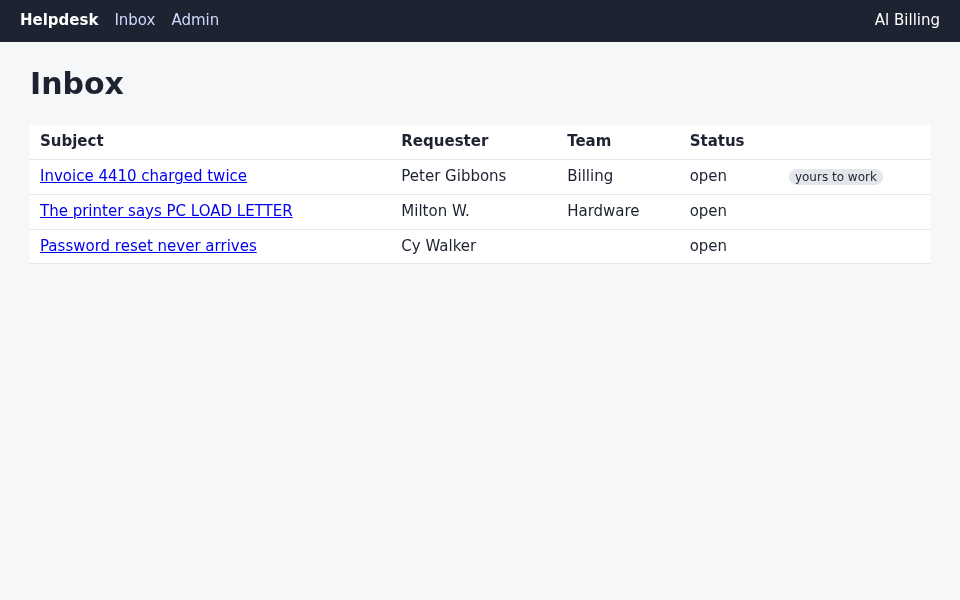
npm run dev                    # http://localhost:8002: sign in as any of the demo's people (db/seed.sql)
npm run tick                   # beside it, as the owner (DATABASE_URL): the sync index's clock (Live, below)
While changing the policy, rowstile dev applies it on every save, runs its tests and rewrites the client (src/authz_client.ts); rowstile migrate --name what_changed writes the migration Prisma runs.
The tenant boundary, in the policy
A workspace's people, tickets and roles are its own. The schema holds that once: every row of a workspace names it, and a row that points at another names the same workspace in its foreign key ((workspace_id, team_id) to teams (workspace_id, id)). The policy says it again, in the permissions themselves:
can work  = ((assignee or team.member or team.oversee or roles) and workspace.agent) or workspace.work_all or responder
can reply = work or ((requester or cc) and workspace.member)
Why twice: rowstile prove and the review read the policy, not the schema. Written there, the boundary is something they can check. The four invariants at the end of the policy (no one sees a ticket of a workspace they aren't in, but for the vendor's staff by break glass and the workspace's own integrations) hold in every world prove tries. Without the and workspace... parts, it finds an assignee, a requester or a custom role from another workspace in a few worlds: rows the keys forbid, but a policy that would allow them.
The rules, and where they are
| What the app does | How the policy says it |
|---|---|
| A workspace's tickets, people and teams are its own | and workspace.agent / and workspace.member in work and reply, the invariants, and the schema's composite keys |
| Agents see the workspace's tickets, and work those of their teams | can view = reply or workspace.agent or ..., can work = ((assignee or team.member or team.oversee or roles) and workspace.agent) or ... |
| A team's lead works the teams inside theirs | can oversee = lead or parent.oversee on teams (inheritance, kept in a closure table) |
| A workspace may open its queue to every agent | can work_all = admin or (agent and {open_queue}) |
| Agents hand tickets on, and still see them after | update after : workspace.work or requester: the row after the change, as Postgres also asks that its author may read it (see below) |
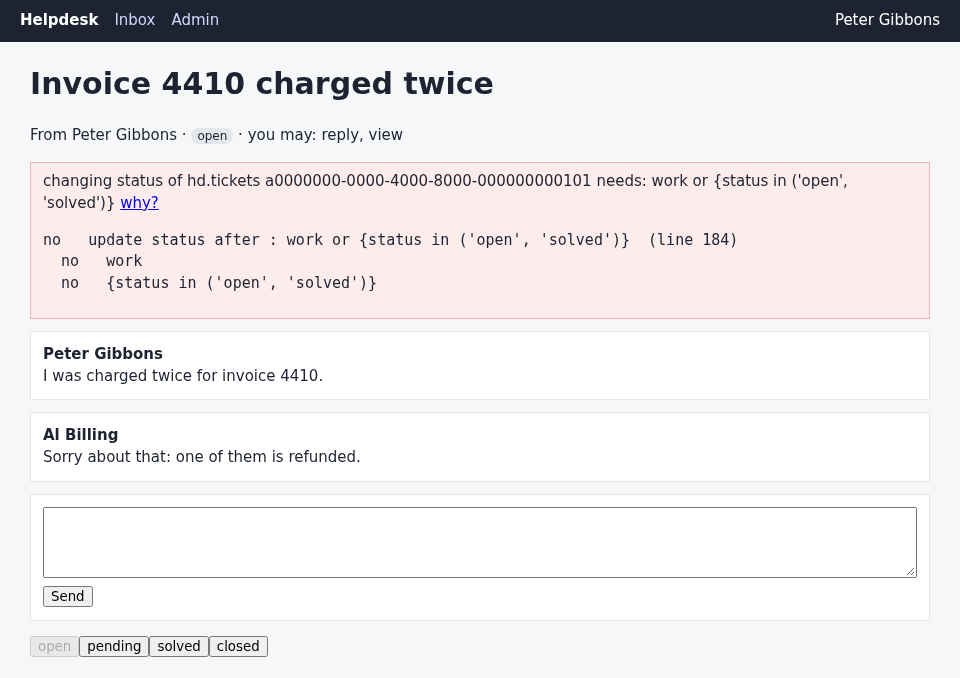
| Customers open tickets in their workspace, unassigned; they solve and reopen theirs, never a closed one | the insert rule's requester and {status = 'open' and team_id is null and assignee_id is null}; update status : work or (requester and {status <> 'closed'}), update status after : work or {status in ('open', 'solved')} |
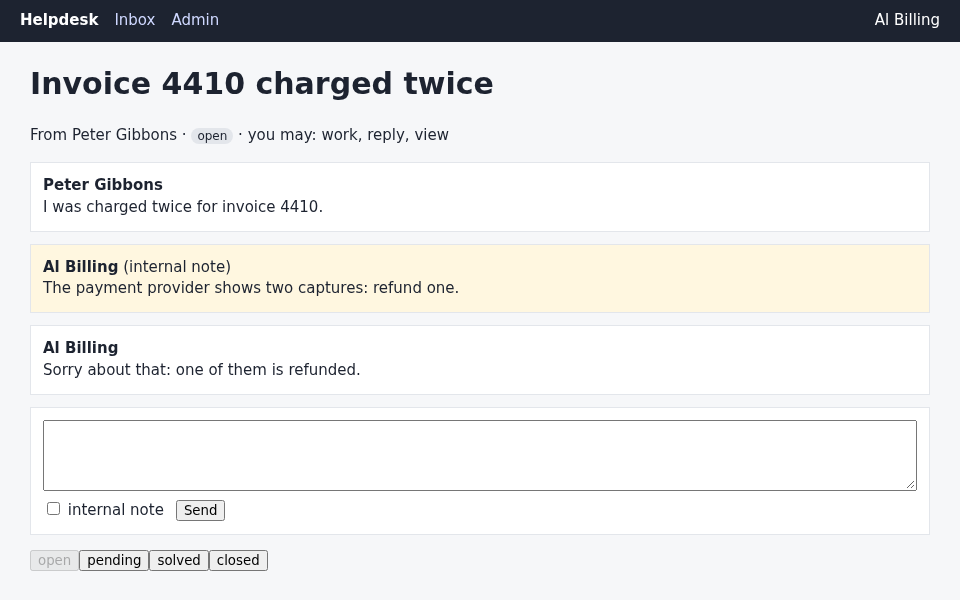
| Internal notes are for those who work the ticket | can view = ticket.work or (ticket.view and {not internal}) on comments, and the insert rule |
| A customer org's people see each other's tickets, if it says so | can see_tickets = member and {shared_tickets}, and requester.org_tickets in the ticket's view |
| Copying a colleague in: only someone of the ticket's workspace | cc : user shared by reply if {hd.same_workspace(this.object_id, this.subject_id)} |
| A workspace's people see its agents (a customer sees who answered them), and customers see only themselves and their org's people | can view = self or workspace.work or (org.member and workspace.member) or (workspace.member and {kind = 'agent'}) or ... on users |
| The agents' notes on a customer: no one else reads them | rules hd.users view hd.users_visible, mask notes : see_notes: the column is null in the view for anyone else, and the table refuses it to everyone |
| Custom roles, made by a workspace's admins, count for its own agents only | roles : user, team#member from workspace, and roles and workspace.agent: a role given to someone of another workspace gives nothing |
| The vendor's staff come in by break glass, where a workspace lets them; they work and reply on the ticket, and change none of its fields | support : user = hd.support_access(...) where {until > now()}, can break_glass = workspace.support, and responder's shared if {hd.is_staff(...)}, which break glass asks too; update after : workspace.work or requester |
| An admin views the app as someone of their workspace | can impersonate = workspace.admin on users; every transaction goes through authz.view_as while they do (src/db.ts): read-only, on the record |
| The email intake signs in as itself, with a key that can do nothing else | type integration = hd.integrations (id uuid) principal, scope intake = ..., and a key made by an admin (can manage_keys = workspace.manage) |
| A person's name is theirs or an admin's to change | update name : self or workspace.manage |
| The intake knows a mail's sender by their address, which only an admin changes; a reply by mail is from someone who may reply | update email : workspace.manage; the intake (app/api/intake/route.ts) asks authz.can(..., 'reply') as the sender, and writes the reply as itself, the sender as its author |
Each row of this table is checked in db/tests/rules.authz (rowstile test), and the app's routes again in tests/api.test.ts, over HTTP, as the demo's people.
Live
The inbox and the ticket page update as tickets and comments arrive, change or leave, through Electric (a preview in rowstile, docs/stacks/electric.md). Electric reads Postgres by logical replication, where row-level security doesn't run, so the policy's sync lines keep an index of who may read each ticket and comment:
sync role hd_electric
sync hd.tickets : view
sync hd.comments : view
The app's route app/api/shapes/[table]/route.ts stands in front of Electric: it asks the database who the request is, and hands Electric that person's shape, whatever the browser sent. A request with no one signed in gets a 401; an admin viewing the app as someone gets a 403 (the index holds what each person may read, not what a limited session may). When a share ends or a ticket is handed on, Electric sends a move-out rather than a delete, which its own client doesn't apply: src/live.ts does. Electric's role and its publication are in db/electric.sql and the migration electric_publication.
A share that ends with time, as break glass's does after its hour, changes who may read the ticket with no write, so nothing tells the index. The database refuses the staff at once; the index learns of it at the next authz.sync_tick(), and Electric then sends the move-out. That function is an administrator's, which the app role can't call: jobs/sync-tick.ts runs it every minute, as the tables' owner, in a process of its own beside the app (npm run tick), so the web server never holds the owner's password. Until it runs, the staff member's shapes keep the ticket, its internal notes and its changes: run it as often as break glass should end live.
tests/live.test.ts follows the shapes as the demo's people: a ticket someone is copied in on arrives, and leaves when the share does; an internal note reaches those who work the ticket and never the customer; a ticket arrives for the vendor's staff when they break the glass, and leaves with its internal notes when the break glass ends (test.sh ticks every second).
What it costs: every agent of a workspace sees its tickets, so each ticket's readers are one key a person (51 for a workspace of 50 agents), and inserting a ticket keeps them (about 19 ms a ticket there, on a development machine).
Two things Postgres asks
- An update its author could no longer see is refused. An
UPDATEwith aWHEREreads the row, so Postgres checks the new row against the select rule too. A helpdesk where agents saw only their teams' tickets couldn't let one hand a ticket to another team. Here every agent of a workspace sees its tickets, and works only some. - Prisma reads what it writes.
createandupdatereturn the row, so the select rule must hold on the new row, and a key's scope must list the table'sselectas well as itsinsert:scope intakenameshd.users.selectbesidehd.users.insert.
Signing in
The example has no identity provider. Its sign-in page picks one of the demo's people by email (app/api/session/route.ts), through hd.logins, which the policy doesn't govern (it says who someone is, not what they may do), and keeps the person in a cookie signed with HD_SESSION_SECRET. A real app checks a password or an identity provider's token there, and nothing else changes.